
Echeveria (Ech-e-ver-ia)

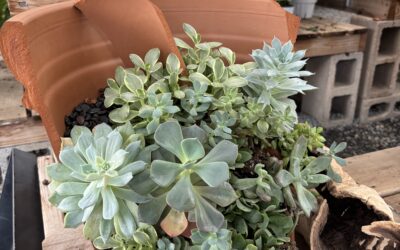
Echeveria is a rather large genius of succulents, with a wide spectrum of colors and sizes that all have showy rosettes. Because of the rosette forming nature of these plants they were first classified as Sempervivum, but in 1828 the genus was named after Antanasio Echeverria, a Mexican botanical artist who had produced thousands of illustrations of the genus. With well over 100 varieties of echeveria they thrive and prosper in many different settings. Many in the americas grow in higher elevations making them more cold hardy and more drought tolerant. These high elevation echeverias grow on cliff sides, thriving in areas that seem uninhabitable. The porous cliffside rocks and inability to saturate their native soil should be a clue for watering echeverias, they will not require much water to thoroughly enjoy a sunny garden location. The Echeveria Imbricata, “Hens and Chicks”, is one of the more hardy echeveria and is able to tolerate lots of sun and heat as well as temperatures down to 20 degrees, making it a highly versatile, extremely hardy, and easy beginner echeveria for a started collection.
More Succulent Tips

How to Design a Succulent Rock Garden

For a dreamy desert landscape full of vibrant colors and fascinating textures, learn how to design your own rock garden with succulents and cacti!

Meet the Mangave ‘Praying Hands’

If you’re always on the hunt for that one plant that stops people in their tracks—something sculptural, easy to care for, and undeniably unique—then allow us to introduce the Mangave 'Praying Hands.' A rare and artful hybrid of Agave and Manfreda, this remarkable...

Euphorbia Dwarf Milii

The Euphorbia Milii is thought to have been introduced to the Middle East in the ancient times, and is rumored to be associated with the crown of thorns worn by Jesus. We don't know anything about that, but we do know that these plants are very hardy, easy to grow,...

Agave Attenuata ‘Ray of Light’

Variegation in plants is the appearance of different colors in the leaves. Typically these colors are white, or yellow, where the zones contrast the more common green foliage. The white, or yellow, variegation is from a lack of chlorophyl in the tissue of the plant....

Alluadia Procera (Madagascan Ocotillo)

Rarely caring leaves, this intriguing succulent tree is full of character. Long, wandering, round stems are covered in vicious grey spines. When it carries leafs, during the spring, the branches are laced with alternating spines and vibrant green, round, sprouts....

Blue Sky Echeveria

We would classify this friendly and vigorous succulent as one of the quicker and larger echeveria. While individual rosettes can grow up to 8” inches wide, it will also offset freely to form large solid clumps over a foot wide. With more sun and colder nights,...

10 Statement Plants to Elevate Your Space in 2025

When it comes to transforming your space, few things have the impact of a stunning statement plant. Whether you’re a seasoned plant parent or just starting your journey, we’ve compiled a list of 10 standout plants to inspire and elevate your home in 2025. Team...

Euphorbia Tirucalli ‘Pencil Cactus’

While the Euphorbia Tirucalli can be a very rewarding plant, we must be very careful in where we plant them and in propagation. The milky white latex found in the plant can be dangerous to the skin and most definitely will cause serious damage if swallowed, or if any...

Echeveria Afterglow

The Afterglow is a unique and striking plant, growing very well in full sun. The short, pink, rosette forming leaves will gain a soft powdery coating adding to their 'glowing' appearance. A relatively quick grower in the spring and summer, but very slow through the...

Top-Selling Plants: Employee Picks You Should Be Stocking

When it comes to choosing the right plants for your inventory, no one knows what’s trending better than the people who live and breathe greenery every day—our plant buyers. We asked our in-house experts to share their current favorites, and their selections are not...

Visit Us Today

Want to Learn more?

More Plant Parenting Advice

Visit Us Today

Want to Learn more?